DeviceBoard – Connected OEMs
DeviceBoard – Documentation
Connected OEM Implementation Using DeviceBoard
End-to-End IoT Platform for Smart Products, After-Sales Services, Predictive Maintenance & Digital Transformation
DeviceBoard enables OEMs (Original Equipment Manufacturers) to build Connected Product Ecosystems across industrial, consumer, energy, mobility, medical, agriculture, and smart building domains.
Using DeviceBoard, OEMs can embed IoT connectivity inside their products to unlock:
• Real-time monitoring
• Remote diagnostics
• Predictive maintenance
• Connected customer services
• Usage-based business models
• Digital Twins of products
• Automated workflows
• AI-driven analytics
• Dealer & service network management
This transforms traditional products into intelligent, service-enabled smart devices, creating new recurring revenue models and superior customer experiences.
1. Why OEMs Need a Connected IoT Platform like DeviceBoard
OEMs face increasing pressure to differentiate through:
✔ Remote monitoring and proactive service
✔ Reduced warranty costs
✔ Improved product reliability through field data
✔ Usage-based billing and leasing models
✔ Over-the-air updates & remote configuration
✔ AI-based predictive insights
✔ Vendor-locked service networks
✔ Customer retention and aftermarket monetization
DeviceBoard provides the complete technology stack to implement these features.
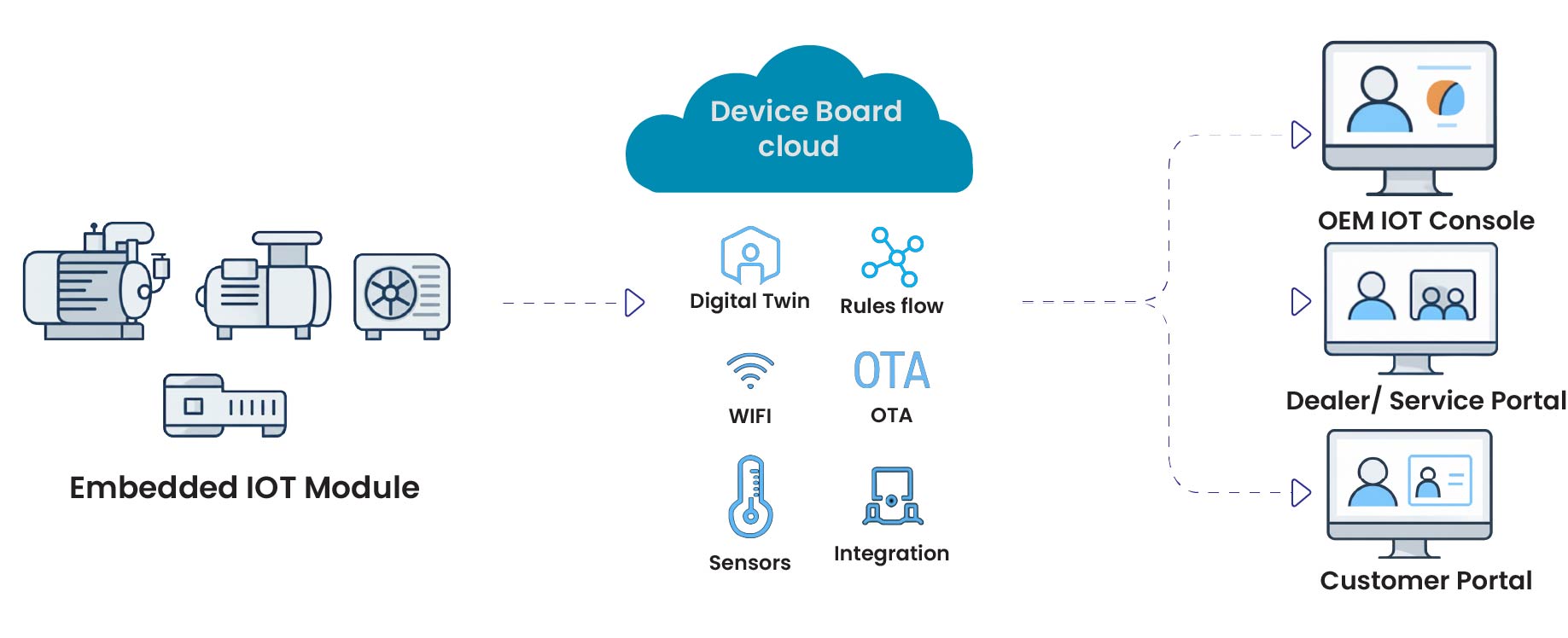
2. Connected OEM Architecture with DeviceBoard
OEM connectivity stack typically includes:
✔ Embedded IoT module / Device Gateway
(MQTT / HTTP / CoAP / LwM2M supported)
✔ Sensor inputs from the equipment
(Vibration, temperature, electrical parameters, operating cycles)
✔ DeviceBoard Cloud
• Device lifecycle management
• RulesFlow automation
• AI inference engine
• Digital twins
• Dashboards
• Alerts & notifications
• Reports
• Secure Device Firmware and Software updates
• Integrations (ERP, CRM, Dealer System, CMMS)
✔ Customer Portal
For end customers to view their own devices.
✔ Dealer / Service Partner Portal
For maintenance workflows.
✔ OEM Admin Console
For enterprise visibility.
3. Device Connectivity for OEM Products
OEMs can connect products using:
✔ Direct IoT Communication
Embedded connectivity using:
• Cellular 4G/5G
• NB-IoT / LTE-M
• WiFi
• Ethernet
• LoRaWAN module
Protocols supported by DeviceBoard:
• MQTT
• CoAP
• HTTP
• LwM2M
• Proprietary gateway-to-cloud integrations
✔ IoT Gateway (if no internet on machine)
For legacy/industrial devices using:
• Modbus
• OPC-UA
• RS485
• CANBus
• BACnet
4. Key Connected OEM Features in DeviceBoard
4.1 Real-Time Equipment Monitoring
DeviceBoard enables OEMs to continuously monitor:
• Machine operating status
• Motor current, voltage, frequency
• Vibration & acoustic signatures
• Temperature & pressure
• Fuel/energy/water usage
• GPS location (if mobile equipment)
• Operating cycles
• Environmental conditions
Dashboards provide product performance visibility across customer fleets.
4.2 Product Digital Twin
Each OEM device has a Digital Twin showing:
• Current operating data
• Performance KPIs
• Health score
• Predictive indicators
• Fault history
• Warranty information
• Configuration parameters
• Custom OEM metrics
• Firmware version
Twins update in real-time and sync across all dashboards and analytics modules.
4.3 Predictive Maintenance & AI Insights
OEMs can deploy AI models to predict failures:
• Bearing wear detection
• Motor overload patterns
• Hydraulic leakage prediction
• Overheating risk
• Pressure anomalies
• Abnormal energy consumption
• Performance drift detection
DeviceBoard AI engine supports:
✔ Supervised models
Failure probability, regression predictions
✔ Unsupervised models
Anomaly detection, clustering, health scoring
Predictions can trigger:
• Alerts
• Auto service ticket creation
• Maintenance scheduling
4.4 OTA Firmware & Configuration Updates (Secure Device Firmware Update)
OEMs can push:
• Firmware upgrades
• Config patches
• Parameter updates
• Safety rule updates
• Diagnostic logic updates
To devices securely over:
• Cellular
• WiFi
• Ethernet
This reduces service calls and operational cost.
4.5 Alerts, Notifications & Fault Management
RulesFlow supports automatic alerts for:
• Overheating
• Motor overcurrent
• Abnormal vibration
• Pressure deviations
• Sensor failure
• Runtime exceeds thresholds
• Predictive failure alerts
• Battery low
• Communication loss
Notifications delivered via:
• SMS
• Email
• WhatsApp (Addon Feature)
• Webhooks
• Customer App
4.6 Warranty Analytics
OEMs can reduce warranty claims by monitoring:
• Misuse patterns
• Overloading behavior
• Out-of-spec operations
• Fault trends
• Warranty status reminders
• Fault classification
This leads to data-backed warranty analysis.
4.7 Remote Diagnostics for OEM Service Teams
OEM service engineers can:
• View real-time machine logs
• Pull historical performance data
• Inspect fault conditions
• Run remote tests
• Apply configuration changes
• Trigger service workflows
This reduces field visits and support costs.
4.8 Dealer / Service Partner Portal
OEMs can create Hub-level user groups:
• Service partners
• Distributors
• Dealers
• Field technicians
Each group sees only their assigned devices via DeviceBoard’s:
• Device Groups
• Asset Groups
• RBAC / ABAC security model
Dealers can:
• Receive fault notifications
• View assigned customers
• Manage work orders
• Run diagnostics
• Upload service reports
4.9 Customer Self-Service Portal
OEMs can offer a branded customer portal:
Customers can:
• View device dashboards
• Track consumption
• View alarms
• Download reports
• Schedule service
• View maintenance logs
• Access knowledge base
This improves customer satisfaction and retention.
4.10 Billing, Usage Analytics & Subscription Models
DeviceBoard supports usage-based business models:
✔ Pay-per-use
(Energy, cycles, hours, mileage)
✔ Subscription renewal reminders
(Fleet equipment, compressors, HVAC, medical devices)
✔ Over-usage analytics
(Helps OEMs recommend machine upgrades)
5. OEM Automation Scenarios Using RulesFlow
5.1 Predictive Maintenance Automation
IF anomaly_score > 0.85 THEN create service ticket + notify OEM technician.
5.2 Warranty Abuse Detection
IF device_overload > 30% for 15 min THEN add warning to warranty log.
5.3 Auto Service Scheduling
IF running_hours > 500 THEN schedule maintenance visit.
5.4 Remote Diagnostic Triggers
IF temperature spikes repeatedly THEN request remote diagnostic logs.
5.5 Customer Notification Workflow
IF filter_blockage_detected THEN notify customer to clean/replace filter.
6. Integrations for Connected OEM Ecosystems
DeviceBoard integrates with:
✔ ERP (SAP, Oracle, Dynamics, Odoo)
- Serial number mapping
- Shipment records
- Warranty records
✔ CRM (Salesforce, Zoho, HubSpot)
- Customer onboarding
- Service ticket sync
- Lead triggers based on product usage
✔ CMMS / Service Management
- Maintenance ticket management
- Field service scheduling
✔ MES (if OEM also operates manufacturing plants)
- Production analytics
- Quality defect prediction
7. Natural Language Insights for OEMs
OEM operations teams can ask:
- “Which machines show early signs of failure?”
- “Generate a report of high vibration equipment.”
- “Create a dashboard for compressor fleet performance.”
- “Show warranty claims with most repeated faults.”
- “Predict next week’s maintenance load.”
DeviceBoard automatically visualizes insights or generates reports.
8. Strategic Benefits for OEMs
| Benefit | Description |
|---|---|
| New revenue models | Predictive maintenance, subscription services |
| Reduced service cost | Remote diagnostics + AI predictions |
| Lower warranty claims | Data-backed analysis of equipment misuse |
| Better product design | Insights from real-world usage |
| Customer loyalty | Branded portals, proactive support |
| Operational efficiency | Dealer dashboards, automated workflows |
| Scalability | Millions of devices supported |
| Unified platform | Telemetry, video, AI, dashboards, automation |